
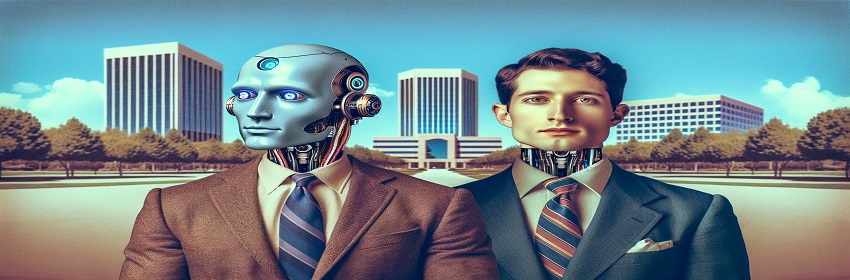
Artificial intelligence (AI) is not likely to cause the demise of the human race. Instead, AI-like humans are more likely to trigger our downfall.
These AI-hybrid humans will not be half-human, half-machine cyborgs, as depicted in the movies. Instead, they will be fully human, driven by their burning desire to dominate others. They will not ooze typical human characteristics such as empathy, social awareness, humility, and concern for others. These flesh-and-blood hybrids will be laser-focused on leveraging technology to acquire wealth and influence. We already have prototypical hybrids, such as Elon Musk, Peter Thiel, Jeff Bezos, Mark Zuckerberg, Larry Ellison, and David Ellison. You probably recognize most of these men, except for maybe the Ellisons. More about them later.
How Could this Happen?
Science fiction writers have long explored the rise of artificial intelligence, with some envisioning it embedded in human form. Some authors, such as Isaac Asimov, while wary of the dangers of uncontrollable robotic entities, nevertheless developed optimistic literary devices (his three laws of robotics) that gave us comfort that this new technology might not result in the end of humankind.
Before we explore why I think Asimov’s optimism might be unfounded, let’s consider the development of artificial intelligence. The basis for artificial intelligence (AI) arose from highly structured thinking and abstraction. AI could not exist without digital computers that use structured instructions created by humans or other computers. These instructions were and are developed within the context of a series of rigid rules. Without frameworks of embedded rules, AI could not exist. In the computer code system UTF-32, the lowercase “g” is “0x00000067”. A computer that thinks a simple “g” is “0x00000167” will create computer chaos.
How did humans who lived in caves a few thousand years ago learn to create such abstract, structured systems? There are many precursors. When humans learned to use fire and cook their food, they spent less energy digesting their meals and diverted more of their biological activity to developing larger, more complex brains. Humans learned to use tools and communicate with one another. After a few thousand generations, humans developed agriculture and stable communities.
Eventually, many human cultures developed competitive impulses and complex societies that required control and regulation through rules and bureaucratic structures. Eventually, as societies became more structured and bureaucratic, they industrialized. Industrialization and the development of simple communication systems, such as telegraphy, led to increased structure and rules. Electrification and transportation advances led to a new cycle of rules, regulations, and impersonal interactions. Suddenly, humans could interact with another person on a different continent in minutes, rather than months. However, these distant interactions required that all participants live by the same structured, bureaucratic rules.
While rules allow for more efficient business and interpersonal communication, they can also stifle innovation, individual freedom, and even meaning. Interacting with the farmer on the nearby farm is direct and personal. Interacting with a “market” that mysteriously fluctuates without rhyme or reason is impersonal and makes the farmer believe he has no control over his goods.

Caught in this endless requirement to follow the rules, the rules become everything. Farmers plant the crops that the market statistics dictate. Students study the disciplines that are currently the most popular. Politicians join a party and follow the party’s dictates lockstep. People in business create and market products they think their customers want. Computer geeks are paid well to create increasingly complex computer-based systems that separate humans from authentic human experiences. We are rapidly approaching a new virtual world that is inhabited and constrained by digital rules, currencies, and faux human interactions.
Even with the structured logic and unlimited access to the world’s information, artificial intelligence and the people who create it need a solid moral and common-sense foundation. Without a solid foundation, the AIs created by some tech bros will have bizarre characteristics, reflecting the uncontrolled hubris of their creators. It is ironic that, although AIs employ highly structured logic and advanced mathematics, the engrams imprinted in their AI brains by their creators often lead to random glitches and psychopathic traits, which are derived directly from the engineering minds that lack human empathy. They behave and talk like human robots one minute and act like spoiled children the next. There have already been bizarre demonstrations by some of the prototypical AI tech bros that should give us all pause for thought.

The Fracturing of the American Community
How did we arrive at our fractured virtual world, where excitement and ignorance now prevail over logic and facts?
America once leaned towards shared logic and facts when there were just three major television networks. Our communal discussions were more civil, and most of us believed, as Daniel Patrick Moynihan once said, “Everyone is entitled to his own opinion, but not his own facts.” Most Americans watched and trusted Johnny Carson and Walter Cronkite before the 1987 Fairness Doctrine was repealed at the end of the Reagan term. The Fairness Doctrine required news platforms to provide fair and balanced reporting. The absence of fairness has led inexorably to new channels that fabricate facts and generate propaganda. Coincidentally, the internet, with its ability to monitor and target individuals, became a public utility in 1993. These two facts allowed America’s large public square to fragment into a thousand small islands separated by ancient tribal rumblings and personal resentments.
Silicon Valley
Before 1993, most communication was either one-to-one, usually via telephone, or mass communication via print media, radio, or television. People needed to acquire access to a printing press, a radio station, or a television station to communicate with a large audience.
After the internet became a public utility, the world underwent significant changes. The internet allowed us to send electronic mail to one person or thousands in seconds. A single person could create or buy a website that was accessible to millions. The internet enabled advertisers to reach new, targeted audiences and receive instant feedback in ways that were previously impossible. The list of radical changes is endless, and Silicon Valley was the epicenter of the Internet earthquake.
A common misconception about Silicon Valley is that it is inhabited by a bunch of laid-back hippie techies who lucked into promising, well-paid careers. Steve Jobs often represents the archetype of this version of Silicon Valley. Nothing could be further from the truth, both in general and specifically about Steve Jobs. While there are many laid-back techies in Silicon Valley, those who controlled Silicon Valley businesses, like Steve, were never laid-back. Fully engaged engineers, scientists, and investors established the foundations of Silicon Valley. Hewlett-Packard, the Stanford Industrial Park, Varian (microwave pioneer), Shockley Semiconductor (the developer of the first silicon chips), Fairchild Semiconductor (first integrated circuit), Intel, Atari, Apple, Oracle, eBay, Google, PayPal, Facebook, Nvidia, Adobe, Cisco, Palantir, Neuralink, and Tesla were all started in Silicon Valley. Silicon Valley was not the sole origin of modern technology, but it is and has been a major center.
The technology coming from places like Silicon Valley was not funded by the profits of tech start-ups. Start-ups rarely made a profit. Moreover, most start-ups went bust after a few years. Silicon Valley was financed, in a Gold Rush-type atmosphere (particularly around 2000), by lots of individual investors who hoped to invest one million dollars in the early start-up phase, anticipating ownership of shares worth twenty million or more when the company went public.
Over time, Silicon Valley developed a cadre of venture capitalists who became increasingly structured, hard-nosed, and successful. They translated the engineering mentality of the techies into a rigid, rule-based approach focused on a return on investment. While people around the world associated California with hippie countercultural ideals, the reality was that many in Silicon Valley were very conservative and focused on acquiring a maximum number of corporate shares. Most engineers were laser-focused on developing tech products that would allow them to retire with millions before the age of 40, and many succeeded. Most investors, also known as tech bros, were even more conservative and power hungry than the working engineers.
Tech Bros
Some techies want more than a comfortable retirement. Most tech bros want to control the world.
As the saying goes, history does not repeat itself, but it does rhyme. We can visualize Andrew Carnegie and John D. Rockefeller sitting behind their respective desks in the 1880s, devising ways to accumulate more wealth and influence. Today, we see Elon Musk and Peter Thiel pacing their floors, inventing new ways to con politicians and establish virtual monopolies that lock customers into their products.
There are numerous companies worldwide vying to dominate the technology sector. It is hard to know what other countries are doing, but the modus operandi of American tech bros is becoming increasingly transparent. Let us examine the goals and activities of a few of their operations.
A little-known company, founded by Alex Karp, Joe Lonsdale, and Peter Thiel, has fewer than 4,000 employees but boasts a market capitalization of $368 billion. Palantir is not a free app FOR the masses. Rather, Palantir is a tool for large government and corporate organizations to integrate data collected FROM the masses. While most of us are aware that Google tracks our browsing habits, Palantir enables “Big Brother” to collect and compile comprehensive profiles on each American person and organization.
Americans typically use fiber optic, wireless technologies, and conventional coax cables to connect to the Internet. Geosynchronous satellites provide an alternative to the Internet for areas not served by other services. The problem with these satellites is that they are 22,236 miles above the Earth’s surface, and the speed of the signal is too slow. There is a delay (or latency) of at least one-quarter of a second. This may not sound like much, but it is a significant problem for most users.
Starlink Services is a replacement for land-based and geosynchronous services and is a wholly-owned subsidiary of Elon Musk’s SpaceX. Starlink is a low-latency internet service provider. As of May 2025, Starlink consists of over 7,600 small satellites in low Earth orbit (only 1,200 miles above the Earth). The idea for these low-Earth satellites first arose during the Reagan Administration under the Strategic Defense Initiative (aka, Star Wars). Starlink offers nearly worldwide Internet coverage to approximately 130 countries. They are planning to compete with Verizon, AT&T Mobility, and T-Mobile by entering the mobile broadband market.
Starlink appears relatively benign and excellent technology to many until we discover that it is also being used in a secretive game of global power. The Wall Street Journal and others have reported that Elon Musk has used Starlink to compel people and entire countries to conform to his business and political will. When the top court of Brazil threatened to sanction Musk’s X (formerly Twitter), Musk told Brazil that he would not comply with their order. Elon Musk has also been in regular contact with Vladimir Putin. Putin urged Musk to withdraw and not install new Starlink services in Ukraine and Taiwan (to appease Communist China). Musk has also pressured the US Department of Commerce to use Starlink for the agency’s rural broadband program. Finally, Musk’s involvement in DOGE introduced so many conflicts of interest that even school children could understand.
Many more tech bros are trying their best to control one or more aspects of the world. Thiel and Musk are two prominent examples.
One Recent Example of How the Tech Bros Operate: The CBS/Paramount Merger
Silicon Valley now has a second generation of tech bros. Steve Jobs’ friend Larry Ellison founded the wildly successful Oracle Corporation, which provides database software for many of the world’s largest businesses. Like many champions of Silicon Valley, Ellison gives to both major political parties. However, he tends to donate ten times more to Republicans than Democrats. Like many modern-day Robber Barons, he tends to support the Libertarian wing of the Republican Party.
Although Larry Ellison has been married almost as many times as Henry VIII, he found time to have a son and a daughter in his three-year marriage with his third wife, Barbara Boothe. Despite dropping out of the University of Southern California, Larry’s 42-year-old son, David Ellison, is the CEO of a company named Skydance Media. Skydance will merge with and take control of Paramount Global on August 7, 2025. Skydance is also purchasing National Amusements, a chain of movie theaters.
These acquisitions have been in the news for some time. Still, when it was revealed that the long-running The Late Show with Stephen Colbert on CBS, many people suddenly realized that something significant was happening. Paramount Global is a large entertainment conglomerate with major divisions, including Paramount Pictures and CBS News and Entertainment. While David Ellison’s Skydance has recently had several hit movies, it is surprising to see a small media company acquiring two storied news and entertainment enterprises. However, Paramount’s two major divisions have seen their market value decline steadily over the years, and the buzzards have been circling overhead.
After the merger details were finalized, the SEC, European Commission, and FCC needed to approve the merger. By some odd twist of fate, there were several overt concessions to the Trump Administration before the FCC approved the merger. Paramount paid Donald Trump $16 million to settle a lawsuit by Trump claiming that CBS’s 60 Minutes deceptively edited an interview with Kamala Harris. The Late Show was cancelled. The merger also requires CBS to eliminate all diversity, equity, and inclusion programs and to be committed to unbiased journalism.
What was behind all this? Perhaps there is an invisible hand at work. Was it the invisible hand of capitalism, the Trump Administration, the Tech Bros, or all of the above?
I am sure we are all looking forward to the new and improved “unbiased” journalism and entertainment to come out from the Paramount Motion Picture Group, Nickelodeon, Comedy Central, Showtime, the Smithsonian Channel, Paramount+, CBS News, CBS Sports, and other Skydance media channels. Finally, David Ellison will utilize his father’s Oracle database and cloud services to automate, structure, and incorporate artificial intelligence into the new merged enterprise.
Conclusion
In the days of Clark Gable, Johnny Carson, and Walter Cronkite, the media did not monitor our every move. It was a one-way flow of news and entertainment. They provided us with news and entertainment, and we consumed it. The news and entertainment of tomorrow’s media tycoons will be much more engaging but also more intrusive into our lives. The mass media of 60 years ago had the power to shape and unify our nation. The targeted, AI-driven media of tomorrow has the potential to fracture our nation by segmenting the nation into thousands of separate media markets.
In a stark reversal over the last 60 years, companies like Skydance, Neuralink, Facebook, Palantir, and Google have been, and will continue to be, more robustly consuming us, rather than the other way around. There is hope that AI will usher in a golden period of human development and prosperity. However, AI controlled by greedy politicians and tech bros will not benefit the 99% of humanity.
If the tech bros and their political allies take away America’s traditions of democracy, truth, and freedom, we will be left with autocracy, lies, and subservience. Autocracies inevitably lead to a police surveillance state because the rulers will not want rebels or free thinkers in their countries. Is this what we want to leave to the next generations?