
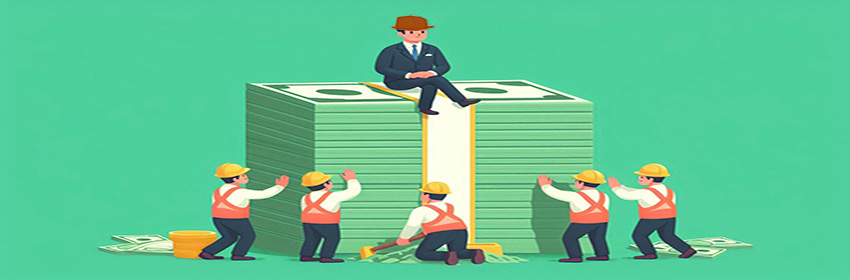
America has had a few very intractable problems that tied our society in knots. In the 19th century, it was slavery. After the Civil War, the most significant issues revolved around economic prosperity and inequality. We’ve had many economic ups and downs with winners and losers. Ironically, both are now unhappy. The losers are resentful, and the winners want even more.
A Gordian Knot is a hypothetical problem that seems unsolvable. Cutting the Gordian Knot is said to be a simple, bold way to solve the problem. According to legend, Alexander the Great solved a seemingly impossible problem by boldly slicing the knot in half with his sword. Greek mythology says all previous attempts to untangle the Gordian Knot delicately failed, but Alexander found a simple, direct solution.
What is America’s primary Gordian Knot? America has many complex problems, but the most significant is the disparity between the rich and the poor. Class warfare has flared up occasionally in America, but unlike in most parts of the world, it has never reached the same levels of conflict. America has been blessed with lots of land, resources, and people. Its founding politics and economics were based on the European Enlightenment and the Industrial Revolution. Unlike China and Russia, America was not forced to transform itself from a peasant society in the twentieth century. Likewise, in comparison to Europe, America never had a full-blown manorial style with lords who owned large estates and serfs who worked for the lords.
Over the centuries, America has benefited from lots of free or nearly free land; when the going got tough, we travelled west. This westward migration acted as a safety valve for much of the potential animosity between the rich and the poor. If a group of poor people felt they were getting a raw deal from their wealthier citizens, they just moved west.
By the 1890s, the good “free” land was diminishing. The wealthy class owned coal mines, railroads, steel plants, and banks. America’s unfettered, laissez-faire climate and legal system allowed this wealthy class to gain unprecedented monopoly power over the economy. President McKinley instituted a system of tariffs to protect many of the wealthiest monopolies from foreign competition. These men manipulated prices, bribed politicians, and exploited workers in their factories and mines. These men were known as the Robber Barons, and a partial corrective political action followed between 1900 and 1920.
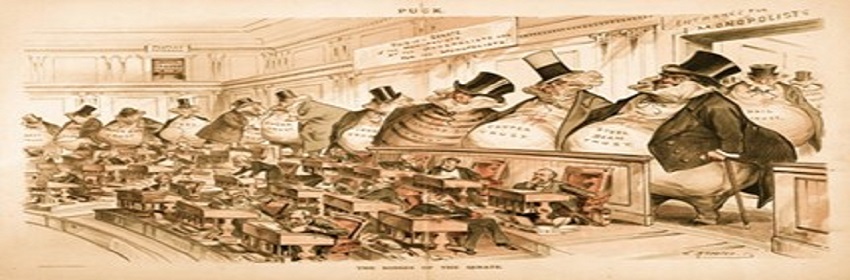
The greedy people temporarily regained control of the Federal government in the 1920s, and America’s worst economic calamity, the Great Depression, occurred after President Hoover signed the Smoot-Hawley Tariff Act in 1930, which sparked a global trade war. Since the Great Depression, subsequent economic busts have usually followed periods of lax financial controls or economic blunders.
So, why does this cycle continually repeat? It is partially human nature. Once many people, companies, or countries feel financially comfortable, they loosen their restraints and financial controls and speculate or spend more than they should.
Another reason is the almost uniquely American fear of equality. America’s wealthy class does not want the class warfare that enveloped France during their Revolution, Russia during their Revolution, or Spain during their Civil War. America has always paid lip service to equal opportunity, but “actual” equality or economic fairness has never been a national goal. America continually allows conniving people to create legal loopholes that enable them to compete unfairly in the financial marketplace. For an advanced democracy like America’s, how is this possible? Why does America preach “equal opportunity” to the world on Sunday but practice cutthroat crony capitalism the other six days?
One reason for this duplicity or anomaly is the ever-present fear of sliding into socialism, which is hardcoded into our historical narrative. Almost everyone, even many of the working poor, embraces this fear. Socialism tends to be the phantom that might level the playing field, and this fact is terrifying to America’s upper crust. Their anxiety is routinely transmitted via the mass media they control. This subject is complicated, and I will not flesh out all the details. Suffice it to say that America does not truly support equality.
The lack of commitment to equality inevitably leads to greater inequality. Reagan’s voodoo economics (i.e., The Economic Recovery Act of 1981) did not lift all boats; it gave tax breaks to the wealthy. Trump’s 2017 “tax reform” only benefitted the ultra-wealthy. The collective American political system, which includes Democrats, Republicans, Libertarians, and Independents, has not truly sought to redress the problem of inequality.
The American economy has done better than most, so why is there so much unhappiness? Even when the average income in the nation’s poorest state is greater than in the United Kingdom, American inequality is a problem. The most current analyses report that 67% of Americans live paycheck to paycheck. This places a lot of stress on workers and their families. Over time, as many in the bottom rungs work hard and see their chances slip away, they grow resentful, angry, and alienated. They play the lottery, disengage from “normal” society, hyper-engage in “normal” society, and look for paths out of their current situations.
Many disaffected people turn to religious, recreational, or political activities to channel some of their frustrations in constructive and non-constructive ways. Political extremists on the Left and Right may invade buildings, hold large rallies, or worse. The motivation for many extremists is based on human nature. People who believe they are excluded from a society or feel they are not treated equally become compelled to destroy their institutions.

The opportunist, Donald Trump, found a simple way to cut the Gordian Knot of inequality and lower class frustration. Instead of spouting platitudes and cogent arguments, he did the opposite. He blathered on about liberal bias, wokeness, the influx of foreigners, being called a racist and a sexist, and being ignored. Since most Americans lack advanced college degrees (68%) and significant retirement assets (86%), many embraced Trump’s simple message of resentment and making America great again. A college education, trips to Europe, health insurance, nights at the opera, and other similar activities are out of the reach of most Americans. Trump’s base might be resigned to their fate, but at least they now have a champion to communicate their anger and resentment.
Liberals tried complex methods, using compelling intellectual, economic, and moral arguments, to untangle the inequality Gordian Knot. New Medicare and Social Security programs were instituted to ameliorate the inequality knot. However, their measures were complex and only partially effective. Trump, in contrast, appeared to cut the knot with his simple message of resentment toward the perceived elites and the “Deep State.” Trump’s base did not improve economically, but in the short run, they felt heard.
The irony is that Liberals believe they support equality but do so only half-heartedly. Trump supporters overtly or implicitly accept inequality, even though most of Trump’s working class base are the victims of inequality. Trump’s oligarchs grind the lower classes into dust every day. Well-to-do liberals look on at the spectacle of inequality and wring their hands but do little to reform the system. They look away to plan for their vacations and other leisure pursuits.

In reality, America’s Gordian Knot has not been cut. Trump’s tactic of dividing America offers catharsis to his marginalized base in the short run. However, in the long run, it only makes matters worse. The inequality knot will only become larger and tighter as Donald Trump, Elon Musk, Mark Zuckerberg, Jeff Bezos, the Koch family, Larry Ellison, and others gain more control over the “free” people of America by bending the Executive, Legislative, and Judicial branches of our government to their wills.
Good read. Being unfamiliar with the term Gordian Knot, I googled the term to find that it refers to “a metaphor for an intractable problem eventually solved by the “ability to think outside the box” to achieve success. Through the years I always thought that we as a people and government, would, in spite of a few hills and valleys move mostly toward a more perfect union. The reason, I thought was that we would, as individuals and as a country, become more educated, informed, empathetic, and reasonable. All that may have been due to the exuberance of my youth (BTW anyone less than 60 is young to me). With all the examples of intractable problems listed, I think the lack of a standard set of facts for all of us to base our decisions and beliefs on is a major problem. In the 70s and 80s you could listen to Walter Cronkite or Chet Huntley or any of the reporters at the three major networks and believe that what they said was accurate, as a matter of fact, since they reported facts, they all said the same thing. Now that we have so many performative reporters on the various networks, you can just keep changing channels until you hear what you want to hear. After finding the narratives you believe, or want to believe, you just absorb the propaganda delivered and slowly adjust to believe exactly what they are saying even if you formerly knew it was probably wrong. Did Ronald Reagan start this by saying that you can’t believe the government will solve your problems when “government is the problem”? Was it when George Bush Sr had Roger Ailes take over his media and ads? It was probably long before that, that misinformation was attempted to be used as a weapon. It’s when there is too much tolerance for intentional misinformation that lying, cheating, and deceit can proliferate. To me this is our current Gordian Knot. THE TRUTH WILL HAVE TO BE THE SWORD!