

A recurring question has popped up recently. Why are some artificial intelligences (AIs) hallucinating? Is this science fiction or robot rumors? To make matters more interesting, it appears that as AIs improve, the problem gets worse.
AI has achieved some remarkable milestones over the last fifty years. Yes, I said fifty years. AI is not a new technology invented by Silicon Valley’s rich, genius heroes over the past five years. AI is an evolving set of technologies that began to emerge with digital computers after World War II. In the 1970s, AI’s big challenge was to defeat a human chess champion. In 1996, IBM’s Deep Blue beat the world chess champion, Garry Kasparov. Today, a smartphone can beat most chess players.
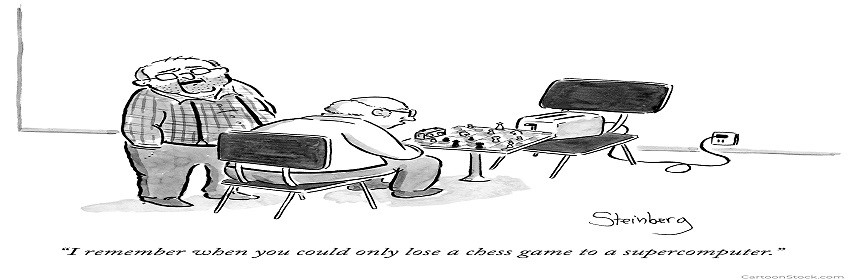
Given Wall Street’s belief that AI holds the key to future financial prosperity, it might be worthwhile to scrutinize the danger of AI hallucinations.
Aside from the many differences between humans and AI technology, they share several things in common. First, humans created AI. Second, AI requires human input to continue evolving. Even if AI became superintelligent, it would still need, for the time being, human hands to assemble cables, chips, and all the other hardware required by AI.
The recent hype about the power of AI has also led to discussions about how AI “thinks” and the results of its thinking. Many of us have found that, while a good AI has more breadth of knowledge than any one human, it still has limitations. Sometimes it is wrong.
As it turns out, most AIs share a common human failing. Like a good con man, most advanced AIs PRETEND always to know the correct answer. Just as a swindler will speak quickly and assuredly, we are swayed to believe everything he says. We may buy that lot in Florida, sight unseen, simply because the con man knows all the answers to our questions.
Not only are AIs programmed by humans, but human technology investors hire the humans who invent the AIs. Investors, particularly those on the frontiers of technology, almost always have a clear path to fame and fortune if they are the first to master a new technology. Since everything is new, the laws and regulations to protect humans are either lax or nonexistent. Moreover, the larger investment community (e.g., trust funds, pension funds, private equity, etc.) clamors for a piece of action in a new, promising technology. The lead technology managers and investors become like a race car driver zooming down the highway at 120 mph with a police escort and seeing nothing but green lights. A slightly imperfect example of this was the case of Theranos. Theranos was a privately held health technology company founded by Elizabeth Holmes in 2003. Her company was the darling of the investment community until it was discovered that the technology was a fraud. Theranos was driven by the Silicon Valley mantra, “Fake it until you make it.” Unfortunately, they couldn’t make it, but it did not stop them from faking it.
Theranos is not a perfect example of the generally uncontrolled nature of technology in the hands of aggressive investors. Many technologies, including AI, have less governmental regulation than a medical technology company like Theranos. [Caveat: medical regulation might go away under Kennedy and Trump.] However, despite Theranos being in the health services arena, with the formerly “tight” government regulation, they were able to fake their services for far too long.
One of the most dangerous traits shared between AI and humans is pretense. An extremely honest person will acknowledge when they do not know something. However, most of us have egos that must be protected at all costs. So, if asked about something that we “sort of” know, we fake it. We pretend to understand and give an evasive answer, deflect by turning the question around, or make something up. If we have a forceful personality or the questioner is in our group of friends, they are more likely to accept our response. This is also how ignorance spreads like a disease. Ignorance spreads when a group of people validates each other’s false facts and beliefs. Instead of examining and challenging each other, they reinforce each other’s prejudices and misinformation. Humans care more about protecting their individual and group identities and reputations, at the expense of truth.
The same can be said for AIs. A recent Cornell University paper said:
“Like students facing hard exam questions, large language models sometimes guess when uncertain, producing plausible yet incorrect statements instead of admitting uncertainty.”
The large language models of AI have been programmed to “guess” or “fudge” answers when confronted with a difficult question. For humans who lack expertise in a given field (e.g., eating boogers), AIs could be dangerous or icky. Someone asked the Google AI “for the health benefits of nose picking” and got an interesting answer, saying that “eating mucus may help prevent cavities, stomach ulcers, and infections, and may also boost the immune system.” In another example, someone asked the Google AI, “How to treat appendix pain at home?” It advised the person to boil mint leaves and have a high-fiber diet.
These hallucinations or bizarre responses from AIs can be clinically explained using AI speak, like the following:
Conventionally, the output of an AI is graded in a binary way, rewarding it when it gives a correct response and penalizing it when it gives an incorrect one.
In simple terms, in other words, guessing is rewarded — because it might be right — over an AI admitting it doesn’t know the answer, which will be graded as incorrect no matter what.
As a result, through “natural statistical pressures,” LLMs are far more prone to hallucinate an answer instead of “acknowledging uncertainty.”
Technically, this hallucination behavior might be a problem that can be overcome. However, we should not discount the greed of managers/investors, the lack of government oversight, and the naïveté of AI users. The track record for industry self-correction has not been sterling. We need only look at Elon Musk’s unrelenting claims that Tesla cars would be empowered by AI to drive by themselves and to act as taxis when the owners weren’t using them. In 2016, Musk said that a self-driving Tesla would travel from Los Angeles to New York City by 2018. As we approach 2026, it remains unclear whether a self-driving Tesla could pass the driving test typically required of a 90-year-old, conducted in a deserted parking lot.
I now loop back to the tendency for AIs and humans to share characteristics. There are many, but perhaps the most dangerous one is the inability to be honest. A truly honest person will tell you that they don’t know something for sure. An honest person can make an educated guess, but will add a disclaimer. A dishonest person pretends to be confident about their guess.
AIs should be completely transparent. They should disclose the sources of their responses and indicate when they are unsure of the answer, providing a caveat or disclaimer. They should not pretend to be honest when they are actually dishonest.
Market forces should weed out the dishonest, hallucinating AIs. However, greedy investors who have invested billions in atomic power plants to enable their AI companies to operate might stay in business by selling their services to other greedy companies (like dishonest insurance companies, credit card companies, etc.) or national, state, and local governments controlled by private interests. There are paths to financial success for deceitful, “hallucinating” AIs that could make con men like Bernie Madoff appear to be small fry in the pantheon of fraud. Dishonest, rogue AIs controlled by hostile corporations or governments could surpass the most catastrophic scenarios imagined by science fiction writers.
Now that Trump has pulled the plug on NIH cancer research, major drug companies will have to depend on their own original research (which they are not doing much of, they like to take university research funded by NIH and profit from it). It is my fear that Trump and crew will now turn basic research over to Elon Musk types, give them huge government contracts, not get much production from them, but demand lots of campaign contributions and absolute allegiance to der fuhrer. Likely we will see dishonest entities controlled by greedy private interests you referred to, like Musk and his space business (charging $8 million/day) instead of leaving the entire enterprise to NASA with tons of experts, direct supervision and not having to pay for the 25% or more net profit.