
We have discussed the deleterious effects of extremism and autocracy in the 21st century. Let’s go back several centuries to review three experiments in which brave people found ways to break the chains of tyranny instead of remaining attached to the umbilical cord of a freedom-sucking autocracy.
As individuals, we tend to be drawn to the strongest magnetic forces in our lives at any moment. Likewise, countries and cultures tend to align with the strongest forces in any given period. In the golden age of monarchy, most European countries or regions used some version of a monarchy to organize themselves. Royal families learned to trade daughters for land as effectively as cattlemen learned to increase their herds. Whether by consent or fear, the people of Europe grudgingly accepted monarchical rule for centuries.
Most Americans lack the “I need a king” gene. Most of us do not want to swear our allegiance to a person. We pledge allegiance to the flag (more so than to the US Constitution), not to a President or a King. However, some countries still need to swear to a living person, even in modern “democratic” nations. The current oath of allegiance in the United Kingdom is as follows:
I, (Insert full name), do swear that I will be faithful and bear true allegiance to His Majesty King Charles, his heirs and successors, according to law. So help me God.
The logic of a citizen’s allegiance to a King or Queen, whether in the Middle Ages or 2023, is bizarre to most Americans. European history has shown time and time again that reliance on royal bloodlines to organize a nation can be quirky at best and catastrophic at worse. Royal intermarriages between different countries were most often diplomatic and property exchanges. Perhaps we can call them sizeable real estate transactions with a bit of sex thrown in to ensure the purity of the bloodline, or was it the property line? Despite the diplomatic advantages in the Age of Monarchs, DNA was often exchanged with close relatives and often first cousins. Today first-cousin marriages would be a big yuk, but in the past, it was not.
Interbreeding within royal families was proven to be a significant problem over time. Modern genetic science shows that human genes are randomly selected amongst fathers and mothers, and those hidden recessive genes can combine within insular families. There have been many cases of unfortunate genetic defects within royal families (e.g., Queen Victoria of England was a carrier of hemophilia, King Charles II of Spain had a severely oversized jaw and could barely speak or eat, and King George III of England suffered from porphyria.) Modern genetics has discovered that consanguinity (e.g., the marriage of close relatives) is potentially dangerous and is banned in most states and countries.
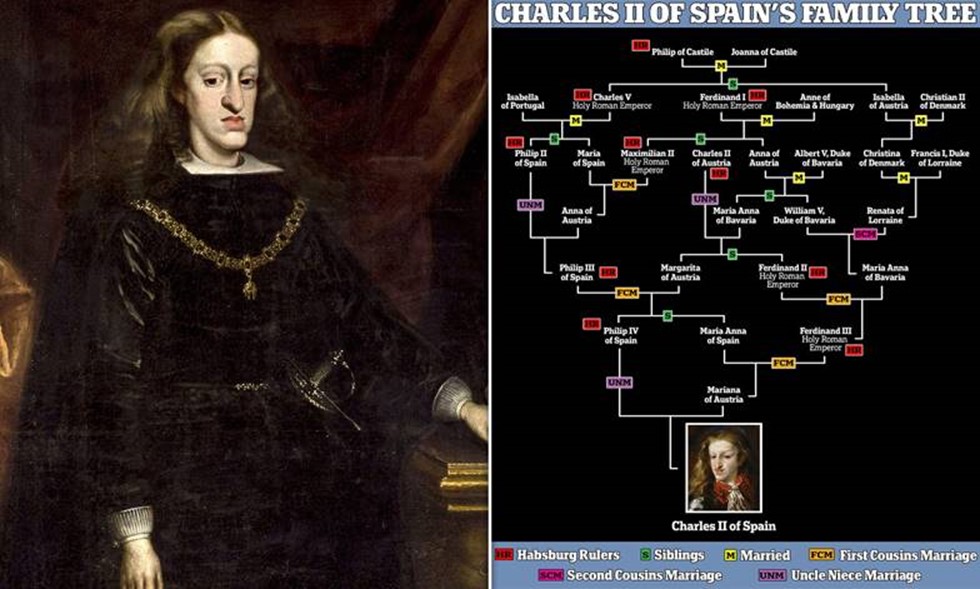
The Habsburg Chin
The Struggle Against Monarchies, Dictatorships, and Other Autocracies.
We will review three experiments that sought to reduce the precariousness of autocratic rule in the Spanish Netherlands, the British Isles, and the British Colonies in North America. Each revolt fought against a tyrannical regime with similar problems. In each case, the monarch (possibly a product of consanguinity) sought to subjugate his unruly subjects as quickly as possible. The rebels’ defeat was likely due to their under-preparedness to fight a larger, more established royal regime. To use the magnet metaphor, the rebels’ magnet poles were far apart and pointing in different directions. How could such disorganized groups succeed against such highly magnetized, autocratic regimes?
Ironically, one of the advantages of marginalized, disorganized people is their diversity and shared experience in the face of autocracy. The tension between diversity and the need for autocratic regimes to force their subjects to follow a single path is a precondition for rebellion. Most dictatorships and monarchs force their subjects to follow one tyrannical set of laws, one religion, and to serve one master. However, as societies evolve, they develop more complicated sub-cultures and economies, which leads to increased diversity. In many rebellions, the more barbaric the oppressors become, the more united the previously unrelated victims become.
It should be noted that the rebellions in the three countries to be discussed were not without chaos and anarchy. By definition, a rebellion seeks to overthrow the existing regime. It may stop with the establishment’s leadership or desire for a complete overhaul of the establishment. As the traditional institutions within a rebelling region broke down, many commonplace activities changed (e.g., couples did not formally marry, law-abiding citizens disobeyed customary laws more frequently, and everyone was forced to choose sides, often leading to community breakdown.) Knowing the difference between “normal” crime and rebellion was probably tricky. Despite the chaos of rebellion, the three examples discussed later sought to replace a tyrannical monarchy with a more democratic government. The Spanish Netherlands and England did not install a modern democracy after their rebellions but made progress toward one.
History is replete with instances of “successful” autocratic rule. However, autocratic rule becomes more problematic as humankind evolves beyond mere subsistence. Information technology might allow modern autocrats to believe they can control an increasingly diverse society. Still, as social psychologists have found, oppressed people find secondary adjustments or circumventions that ultimately undermine autocratic rule.
The evolution of large-scale democracy started in earnest about 450 years ago. Even though disorganized, democracy emerged from the autocratic rule in the Spanish Netherlands, England, and the United States of America.
Autocratic rule has not been magically replaced across the globe. It still exists. However, modern autocrats only have two options: a) slowly eliminate all vestiges of personal freedom and convert their subjects into unthinking automatons through effective propaganda (e.g., North Korea), or b) allow their subjects some degree of freedom. Ultimately, both options will likely result in societal collapse, but the former will be more dramatic, and the latter will take more time. A major fatal flaw for autocratic regimes is ruler succession. This is the problem currently faced by the small city-state of Singapore, one of the few “successful” benevolent monarchies of recent times.
A third option would be world domination by an autocratic country after the collapse of modern democracies. I prefer not to believe that the largely internal forces arrayed against the world’s democracies will succeed. In most stable democracies, for every loud-mouthed fanatic, at least four others will ultimately realize that anarchy and autocratic tyranny are unacceptable outcomes.
The fate of Democracy has been at the crossroads of history before. However, today a growing number of countries without a strong Democracy backbone have become kleptocracies or national criminal enterprises. Criminality is like cancer. It can spread from a single place and invade the whole body of a nation.
The following articles will outline how three societies confronted the oppression of autocratic rulers who sought to control their subjects’ economic, religious, and cultural lives. These societies had to start virtually from scratch. In their bones, they knew that there had to be a better way. It seems that some 21st-century Americans have forgotten this never-ending struggle against anarchy and autocracy.