
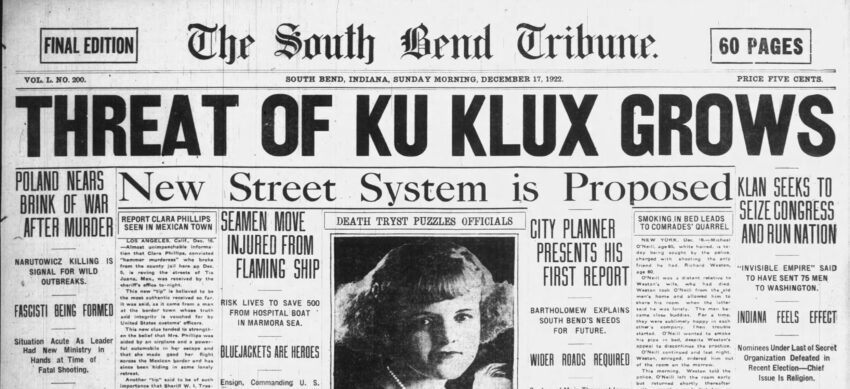
Most of us think of the Ku Klux Klan (KKK) as a racist organization created by “Lost Cause” Southerners after the Civil War, solely associated with the Democratic Party. However, this is not a correct fact.
In 1924, the KKK dominated the Indiana governor’s office. The KKK’s influence in Indiana state politics caused Republican Edward L. Jackson to be elected. Under the direction of the Grand Dragon of the KKK, D. C. Stephenson, the Klan actively campaigned for Governor Jackson. Surprisingly to many modern readers, the KKK was not a fringe group in Indiana in 1924. One in three white men in the state had taken an oath of allegiance to the KKK. Grand Dragon Stephenson created an effective political machine that got out the vote for KKK-endorsed candidates, held rallies, and twisted political arms to support their values and policies.
The election of Governor Jackson, thanks mainly to KKK support, allowed the Klan to acquire immense political power temporarily. As is the case with most twisted, self-serving individuals or groups that have arisen in the USA (so far), their control over the situation was transitory. The success of the KKK in Indiana was short-lived. In fact, the tragic death of an innocent young Indiana woman led to the collapse of the whole unsavory enterprise.
While my primary pursuit is history, I also delve into a subset of history known as genealogy. Genealogy is the study of factual (as opposed to embellished or romanticized) family history and ancestry. As fate would have it, the innocent woman named Madge Oberholtzer, whose death helped create the demise of the KKK in Indiana, was my seventh cousin, once removed. Madge’s 5th great-grandmother was Sytge op den Graeff Cassel, and my 7th great-grandmother. Sytge was a cousin of William Penn, the founder of Pennsylvania. Sytge’s family was from the Lower Rheinland, while William Penn was born in London. Coincidence? Not really. If you study European history, you will discover many interesting interrelationships in genealogy.
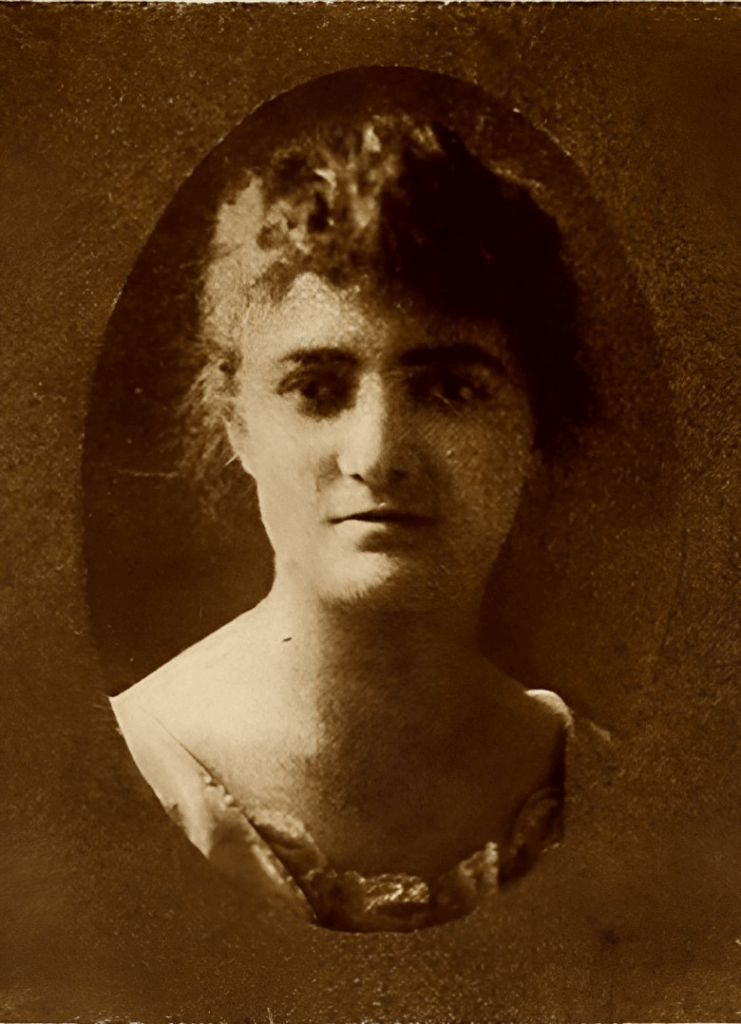
Before the video about the demise of the KKK in Indiana, I will provide a short history of Madge Augustine Oberholtzer. Like my Showalter mother’s family, the Oberholtzers arrived in America before the Revolutionary War and were associated with Anabaptists and Mennonites. Tragically, Madge’s family suffered many losses, primarily due to the nature of healthcare in the 19th century. Her father, George, lost his first wife, and with his second wife, young Madge was born in 1896.
Madge was described as “a free, easy-going, rough-and-tumble kind of girl. She was happy-go-lucky, but always feminine.” She became civically active by participating in fundraisers for various charities. She attended high school in Indianapolis from 1910 to 1914. While she did well in all the required courses, she excelled in her art classes, particularly in painting. Unlike many of her female classmates in high school who married young, Madge enrolled in Butler College (now Butler University) in Irvington, a suburb of Indianapolis. She was initiated into the Butler chapter of Pi Beta Phi, which became a focal point of her social life. After completing her junior year at Butler, her family’s finances suffered a setback when their rental property burned to the ground. Her family was forced to sell their primary house and reduce expenses. It seems that Madge’s education became secondary to their dire financial straits.
Madge was undeterred. Radical change was in the air in 1917. The United States joined its allies in World War I. In December 1917, Madge took a teaching position in Hagerstown, Indiana, after a male teacher resigned his position to join the aviation corps. Later in 1918, she accepted a clerk’s position at the American Central Life Insurance Company in Indianapolis. Over the next four years, she enhanced her employment profile by securing more responsible and higher-paying positions. By 1922, Madge worked in the Indiana Statehouse at the Department of Public Instruction. During this pivotal era, when women were granted the right to vote, attend college, and live independently, Madge excelled. She supported herself and was able to purchase and drive her own Ford Model T. In August 1924, in the era before interstate highways and motels, she and a female companion drove from Indiana to California and back in her Model T.
Madge dated and was pursued by several men. One male friend, Stanley Hill, was connected with the inauguration of the new governor, Edward L. Jackson. Hill asked her to help him with the logistics of the inauguration, which gave her a ticket to the 1925 event. Initially, she accepted the invitation, as it provided her with an opportunity for political involvement beyond her previous experience.
Her interest was piqued when she was seated across from one of the most powerful political operatives in Indiana, Mr. D. C. Stephenson.
Stephenson’s public persona was that of a righteous, temperance supporter who fought for the virtue of women. However, his inner circle knew otherwise. In reality, he was the opposite. His bodyguard, Court Asher, said that Stephenson’s favorite party involved the “old man” playing the Satyr while young women stripped naked around him. He would then whip the young girls, and the one who survived the ordeal received a cash prize.
Like similar scoundrels, such as Jeffrey Epstein in the 21st century, Stephenson had photographs taken of his party guests while they were in compromising situations. There are many authenticated stories about Stephenson’s proclivities, and I choose not to dignify them further.
In 1925, after meeting her at the governor’s ball, Stephenson was in hot pursuit of Madge Oberholtzer. He finagled his way into her life by hiring her to help him write a book about nutrition. The two interacted on several occasions, but there is no proof that Madge had any romantic interest in Stephenson.
Again, I will not recount the gory details of Stephenson’s barbaric behavior toward Madge. Simply put, the most powerful political operative in Indiana, D. C. Stephenson, kidnapped and raped Madge Oberholtzer in March and April 1925. As a result of her criminal treatment, Madge decided to kill herself, rather than to continue his abuse.
Without detailing all the tawdry facts, Madge took a poisonous mercury concoction and became seriously ill. Stephenson’s driver took her poisoned body back to her family home, and a doctor was called.
Madge’s parents were overwhelmed with grief. With the aid of a friend, Madge recorded a “Dying Declaration” about her recent encounter with Stephenson and his thugs.
To summarize a long and complicated story, Madge soon passed away, and her death made headlines around the nation. Stephenson’s character and modus operandi were revealed, and he was convicted of his crimes. He was sentenced to life imprisonment. However, he was granted clemency at age 63 by the “courageous” (the adjective applied by Stephenson) Republican Governor George N. Craig in 1956 after serving about 30 years of his life term.
As Mark Twain said, “history does not repeat itself, but it does rhyme.” The following is a short video about the rise and fall of the KKK in Indiana.