
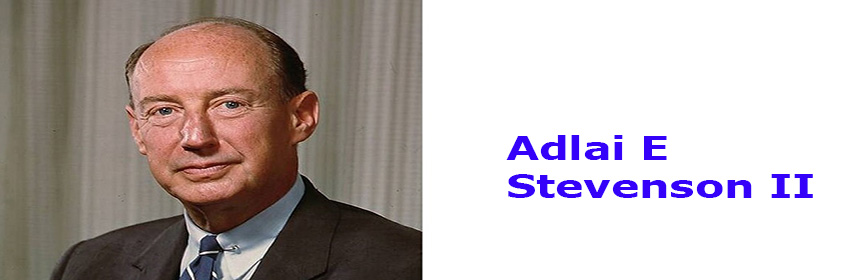
Will the ghost of Adlai Stevenson run in 2028?
For those who care about the past, the Democratic Party was the dominant party in the US Congress from 1948 until 1980. The weaker Republican Party gained small advantages in both houses only once in Eisenhower’s first election in 1952. In the other 15 Congressional elections, the Democrats controlled both houses.
So, why couldn’t the Democrats win the Presidency in 1952 and 1956? Who was/were the candidate(s) for the Democrats? The answer is one man, Adlai E. Stevenson II. He was defeated in both elections. The question many ask is, why did the Democratic Party nominate him in 1956 after losing in 1952?
We can understand Stevenson’s loss in 1952. He was the Governor of Illinois running against the legendary General Dwight D. Eisenhower.
Stevenson appealed to intellectuals, journalists, pundits, and academics. However, to most in the working class, even those who were Democrats, he was perceived as indecisive and aristocratic. The Republicans labeled him as an “egghead” in 1952, and it stuck. General Eisenhower, in contrast, projected the image of a decisive military leader.
The sad truth of any variety of politics is that good men and women may not be the right fit to lead a party. Adlai Stevenson was a good, qualified candidate for President. However, he was not the right man for his time. The leadership of the Democratic Party did not realize this fact, and the voters in the 1952 and 1956 elections agreed.
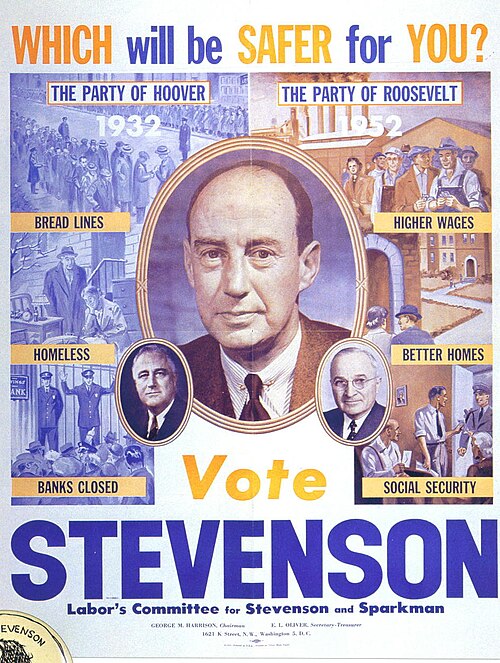
Young, educated Democrats supported Stevenson, and his speeches were so lofty that one ardent supporter wrote, “You were too good for the American people.” The highlight of his acceptance speech at the 1952 Democratic convention was:
When the tumult and the shouting die, when the bands are gone and the lights are dimmed, there is the stark reality of responsibility in an hour of history haunted with those gaunt, grim specters of strife, dissension, and materialism at home, and ruthless, inscrutable, and hostile power abroad. The ordeal of the twentieth century – the bloodiest, most turbulent age of the Christian era – is far from over. Sacrifice, patience, understanding, and implacable purpose may be our lot for years to come. … Let’s talk sense to the American people! Let’s tell them the truth, that there are no gains without pains, that we are now on the eve of great decisions.
It is reasonably apparent that the primary problem with the decision of Democrats to nominate Stevenson twice was his lack of appeal to the less educated working classes. While FDR was more aristocratic than Stevenson, FDR had a common touch and rapport with the working class in America. For better or worse, FDR tried to deliver on his promise of a New Deal.
We see similar results in the Democratic nominations of George McGovern, Walter Mondale, Michael Dukakis, Al Gore, John Kerry, Hillary Clinton, and Kamal Harris. In almost every case from 1932 to 2024, the person perceived to be more of a principled egghead lost. Eggheads do not generally appeal to working-class individuals. Since 35 to 50 percent of American adults are classified as working class, candidates without appeal to the working class will face significant challenges. George W. Bush was the opposite of an egghead, and he was elected twice.
Will it be 1956 all over again? While history does not repeat exactly, there are many similarities between 1956 and 2028. Instead of revitalizing the Democratic Party in 1956 with a new, more working-class-friendly candidate, the party leadership nominated the same passive egghead for president.
Recent years have exposed a widespread perception—both inside and outside the Democratic Party—that its leaders often appear passive or ineffective in confronting mounting political and societal challenges. Working-class Americans perceive this sense of passivity as a significant weakness.
Democrats at the grassroots, including some in the working class, are energized to act and demand change. Almost every time Trump does something offensive or stupid, the streets are filled with Democrats protesting his actions. However, the Democratic leadership usually responds politely and ineffectually. A few leaders demonstrate some sense of urgency, but they do not produce any lasting results. The current minority leader in the US Senate is a case in point. He threatens to send “sharply critical” letters to the President when Trump offends his sensibilities. He appears briefly on CSPAN to express his muted outrage over this or that. Democratic leaders respond with politeness and civility to the aggressive activities in the MAGA world. The Democrats bring toy guns to a knife fight.
For the last decade, the Democrats have been primarily led by several who are in or approaching or passing 80 years old. This is a turnoff to both the working class and young people. Democrats seem to reward tenure, age, and stagnation, instead of new ideas and approaches.
The 2026 Mid-Term and 2028 Presidential Elections
The next two elections are likely to determine the fate of America for the next 20 years. If the country continues down the road of Trumpism, America will be a different country. We will become more like Viktor Orban’s Hungary, Brazil during Jair Bolsonaro’s presidency, or Francisco Franco’s Spain.
The Second Spanish Republic ended in 1939 and was replaced by Franco’s 36-year dictatorship. Does America want the “stability” and economic stagnation of the Franco dictatorship?
Many dictatorships are voted into office. Hitler’s Nazi Party won a place in the government at the ballot box. One thing led to another, and before anyone knew, all Germans had to swear an oath to Adolph Hitler.
As of November 2024, the USA had a vibrant, democratic republic. The USA was the world’s first large-scale constitutional republic that operated under a system of representative democracy. Will America return to its great, democratic roots of the 18th, 19th, and 20th centuries, or will it transition to a Hungarian dictatorship? Will the rule of law govern America, or will we allow a select few leaders to act outside the boundaries of the agreed-upon law?
I do not think it is hyperbole to say that the coming two elections will determine our collective fate.
The Party at a Crossroad
The label of “passive” Democrats is rooted in real divisions and frustrations. Disengagement of crucial voters, dissatisfaction with leadership, and increasingly public rifts between grassroots activists and elected officials have created a turbulent moment for the party. Whether this passivity is overcome may well determine if Democrats can effectively challenge the political shift towards the MAGA-infused Republican Party and motivate their coalition for future elections—or continue to lose support to apathy, alienation, and defeat by nominating the ghost of Adlai E. Stevenson II in 2028.