
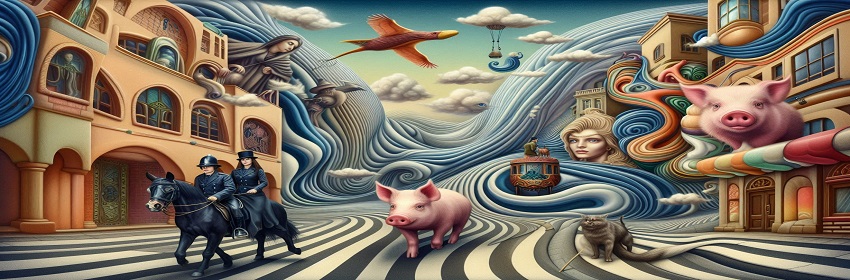
Delusion is Real
Delusion is part of the human condition. Whether we admit it or not, we all misperceive, misconceive, or distort reality at some point or another. However, delusion can become a powerful tool for extremists of all political stripes. They can artfully delude themselves, delude others, or both. Those engaging in industrial-scale delusion typically use some form of communication technology to practice their craft.
Although most humans recognize that what they perceive is not always accurate, we still tend to cling to the belief that everything we think, while awake, we see is real. Studies have shown that crime witnesses are routinely wrong in their eyewitness descriptions of criminal events. This is a problem since a cornerstone of American jurisprudence and its predecessor, the English Common Law, is the sanctity of eyewitness accounts. However, time and time again, there have been rape and murder cases overturned by DNA evidence even though up to five eyewitnesses “saw” the wrong man.
In everyday situations, people can misperceive and/or ignore real events while under the influence of their closed subculture, a chemical or activity addiction, or nihilism.
A subculture that provides all the answers and allows its members to be entirely at peace with their filtered view of reality is probably a cult. When one’s truth is what someone else says the truth is, that person probably has not tried very hard to discover the truth for themselves. Moreover, cult followers usually fall into a comfortable artificial reality controlled by someone who has created a self-reinforcing, delusional reality for cult victims.
Alcohol, drugs, extremist social media, and other forms of diversions from life may result from a psychological emptiness and a temporary sense of relief or euphoria. In any case, artificial chemistry and various addictions often lead to delusional perception and thinking.
Nihilistic people often think that they are the only ones with the courage to take the red pill and face reality without affectation or artifice. Unfortunately, life is more complicated. We are all confronted by many phonies and false narratives. Anyone with a “sane” childhood who was able to have a “sane” adult life is fortunate. Most of us have problems of one sort or another. Nihilism is one approach to dealing with our problems, but by definition, it is an empty one. Nihilism is often followed by joining a cult or an addiction, but it can also be an end in itself. Sadly, because nihilists believe they have no delusions, they miss opportunities to see hope and new possibilities.
The dangers of delusional perceiving and thinking should be obvious. The most insidious aspect of delusion is that it feeds on itself. The more delusional people become, the worse it gets. As more people fall further down the delusional pit, families, communities, and nations suffer.
This is the second in a series of three posts about social media; the next post will follow.